

The Internet’s Gateway Is Changing
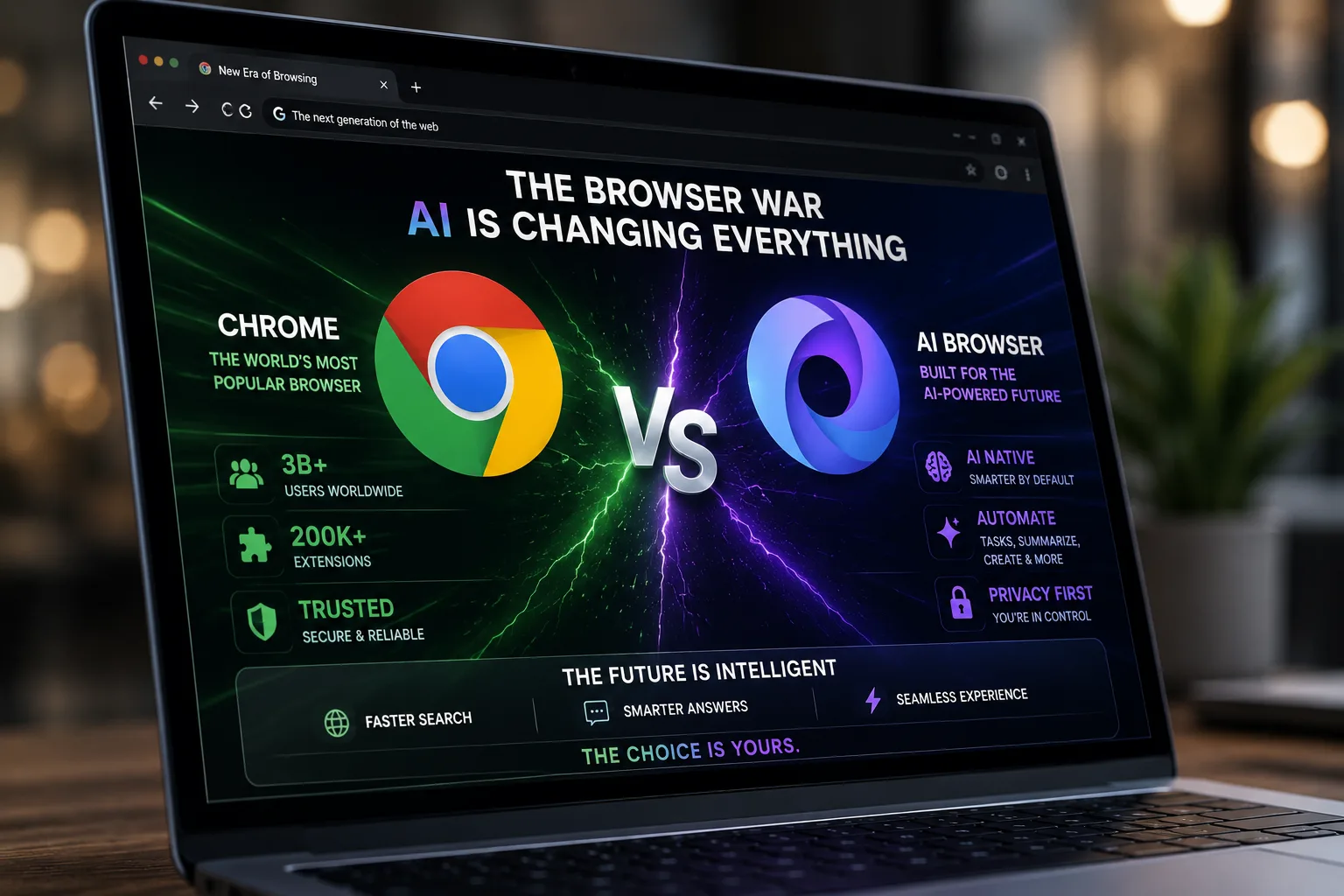
For nearly two decades, opening the internet often meant opening Google Chrome. The browser became so widespread that many users simply saw it as the internet itself, a direct path to searching, shopping, streaming, and working online. Now, that era of unchallenged dominance faces a significant shift in 2026 as the battle for the internet moves from search engines to AI browsers.
This emerging competition marks the first time in years that Chrome has truly significant rivals, reshaping how people interact with the web daily. Companies are racing to transform the browser from a passive window into an active AI assistant.
What Does an AI Browser Do Differently?
Imagine typing a complex request, such as, “I’m a college student who edits videos. Find me the best laptop under ₹70,000 and compare today’s prices.” Instead of a list of blue links, an AI browser would research, compare products, summarize reviews, check current prices, and deliver a complete, curated answer.
This concept moves the browser beyond just displaying information. It evolves into an AI agent that works on the internet for you, performing tasks that traditionally required multiple tabs and manual research.
OpenAI and Perplexity Lead the Charge
The shift is driven by new players like Perplexity, which has already launched Comet, a browser designed around AI search and integrated AI assistants. OpenAI is also reportedly developing its own AI-powered browser, signaling a clear intention to redefine web interaction.
These aren’t just incremental updates; they represent an attempt to change human-web interaction fundamentally. Instead of users jumping between tabs, AI browsers promise features like reading webpages, summarizing articles instantly, comparing products automatically, intelligently filling forms, and performing tasks across multiple websites. The browser stops being a tool you command and starts acting as a proactive research assistant.
Why Is This a Problem for Google Chrome?
Google Chrome boasts billions of users globally, and its strength has always been its deep integration with Google’s search engine. However, AI assistants are now reducing the need to click through traditional search results. If users can ask an AI directly for summarized information or task completion, the volume of traditional search traffic could decline.
This presents a significant strategic challenge for Google. The company is actively integrating its Gemini AI deeper into Chrome to counter these new threats, but the foundational rules of internet interaction are already changing.
Could AI Eliminate Tab Overload?
Many internet users are familiar with “tab overload”—a browser window with dozens of open tabs, from multiple shopping sites to research documents, emails, and social media. AI browsers aim to eliminate this chaos. Instead of opening everything manually, AI can gather and synthesize information across various sources and present a single, coherent answer or complete a multi-step task.
This approach transforms browsing into something less like navigating a maze and more like delegating tasks to a highly efficient research assistant, potentially streamlining workflows and information gathering significantly.
The Big Catch: Privacy Concerns
While the utility of an AI browser is clear, it also introduces substantial privacy questions. An AI browser, by design, processes nearly everything a user does online: search queries, shopping history, emails, documents, passwords, and general browsing habits.
This extensive access to personal data raises critical questions: Who owns this data? How much information does the AI retain? Can it access sensitive details across different platforms? The companies that can best address these privacy concerns and build user trust will likely gain a significant advantage in this new browser war.
The Future Internet May Not Start with Google
For years, websites competed vigorously for top rankings in Google’s search results. In a future dominated by AI browsers, publishers and content creators may shift their focus. The question could change from “How do I rank on Google?” to “How do I get cited by AI browsers?”
This fundamental change could create an entirely new internet economy, where visibility and influence depend on AI recommendations rather than traditional search engine optimization. The browser war is undeniably back, but it bears little resemblance to past battles between Chrome and Firefox. This time, it’s about intelligence, not just speed or features. The winner will be the smartest browser, not necessarily the fastest, and it will help users complete work even before a tab is opened.



Conversation
Comments
Be the first to comment
Add context, a correction, or a question — keep it civil and on the story.