

Perceptron Brings Advanced Visual AI to Industrial Settings
Perceptron, a new startup founded by two former Meta research scientists, launched its latest visual AI model, Isaac 0.5, this week. The software aims to bring advanced artificial intelligence capabilities directly to industrial environments, helping machines navigate complex factory floors and warehouses.
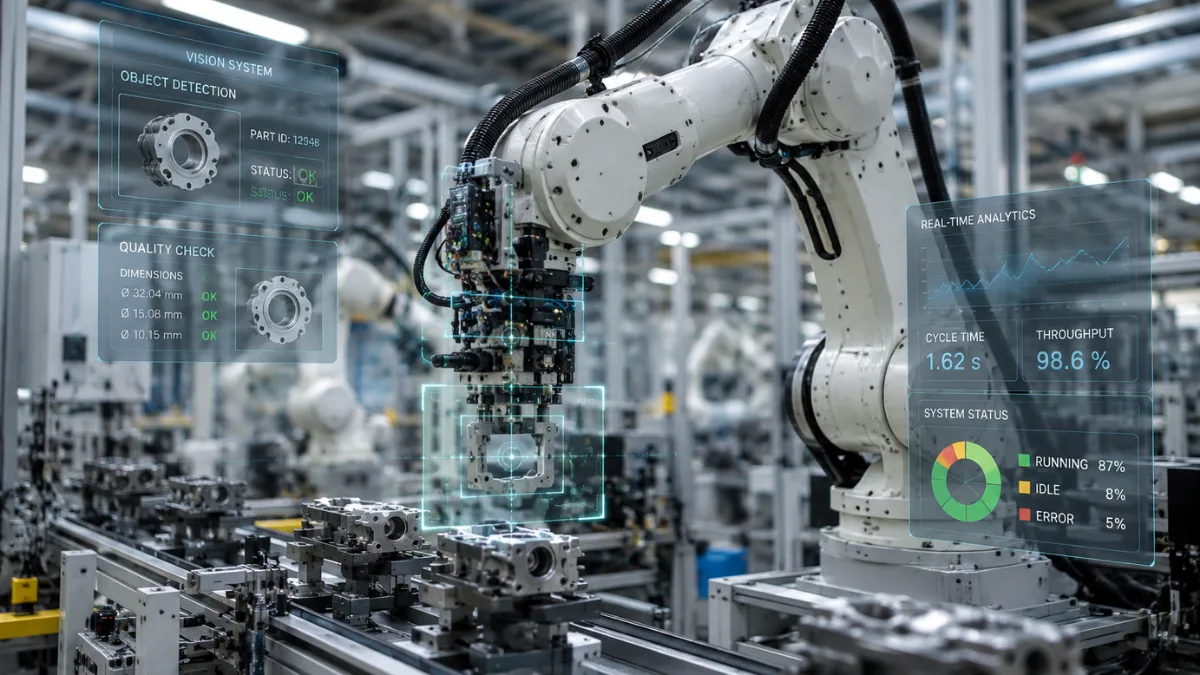
Founded in November 2024, Perceptron develops frontier vision models intended to help machines interact more competently with their physical surroundings. Isaac 0.5, their newest offering, is designed to provide machines with the ability to “perceive, reason and act” in industrial settings. Specifically, the software assists vision-guided robots in complex environments like warehouses, and it helps companies extract visual intelligence from videos recorded by these bots.
Isaac 0.5 is also being released as an open-weight model, meaning its parameters and training materials are openly inspectable.
The startup recently raised $21 million in a funding round led by Bessemer Venture Partners. Co-founders Armen Aghajanyan and Akshat Shrivastava previously worked for Meta’s Fundamental AI Research (FAIR) division. They see their software as the future of industrial automated deployment.
Why General-Purpose AI Matters for Industry
“Physical AI today forces a false choice: generalist foundation models that need multiple dedicated cloud GPUs for every instance, or narrow models that handle perception or control, but never both,” Perceptron states. Existing industrial AI often falls into one of two camps: highly specialized models for repetitive, single tasks, or more general AI that requires significant cloud computing resources for every deployment. This often makes flexible automation costly and complex.
Aghajanyan and Shrivastava say their tool stands apart because it is general-purpose. Unlike systems built for one specific, repetitive action, Isaac 0.5 is designed to adapt flexibly depending on its particular environment or situation. Shrivastava offered a simple example: organizing boxes. “Imagine there’s a robot being deployed to sort packages right now. What are the tasks it would need to do?”
Such a seemingly simple task involves many steps. A robot must read a label, perform spatial analysis to understand box locations, and then decide which one to pick up. If it’s handling multiple boxes, it needs to plan the pickup order. Perceptron’s software helps robots navigate each step. While current industry software can manage many of these individual tasks, few programs offer this level of flexible, integrated problem-solving across varied conditions.
How Do Machines Learn These Complex Tasks?
Models like Isaac 0.5 learn operational skills by ingesting massive amounts of video training data. Perceptron reports that its new model was fed a million hours of general video, teaching its algorithms to identify specific settings, visuals, and scenarios. The company also relied heavily on “ego video” — footage captured from a person’s perspective (often via GoPro or wearable camera) while completing a physical task. Additionally, “UMI video” was used, which similarly helps train AI systems on movements by recording repetitive human actions.
Though Perceptron isn’t disclosing specific sources for its training data, Shrivastava noted that the company has “internally built petabyte-scale data sets that span across modalities, whether it’s images, text, video, etc. all the way through robotic trajectories.”
The Bottom Line
The utility of software that enables robots to operate competently in industrial settings is immense. Perceptron believes it is well-positioned to lead this wave of automation, offering its software to various vendors across industries like manufacturing, logistics, warehousing, security, mobility, and even media and entertainment. Aghajanyan concluded, “Nothing like this really exists out there. We’re really excited about it.”

Conversation
Comments
Be the first to comment
Add context, a correction, or a question — keep it civil and on the story.